

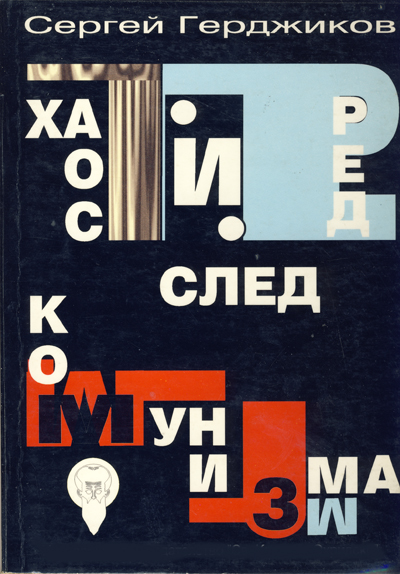
English Contents & Abstract
© 1998, Сергей Стоилов Герджиков, автор
© 1998, Serghey Stoilov Gherdjikov
Chaos & Order After Communism
© Sofia University Press, Extreme Press
© Университетско издателство “Св. Климент Охридски”
© Издателство “Екстрем”
ISBN: 954 – 8418 – 08 – 8
English Contents
Preface 10
Introduction 16
1. Investigation 16
2. Phenomenology & Social Dynamics 22
3. Life forms & Post-Communism30
4. Concepts 37
5. Statements 43
Part I. POST-COMMUNIST DYNAMICS 48
Chapter ONE. The Colapse of Communism 50
6. Dying out 50
7. Implosion 55
8. Unrest 61
9. Pressure 67
10. Explosion 73
Chapter Two. POST-COMMUNIST TECTONICS 81
11. Social Dynamics as Tectonics & Syn-ergetics 81
12. Chaos 88
13. Vagueness 95
14. Fluctuations Up and Down 102
15. Local Ordering 107
16. Stabilities 112
Chapter Three. MENTAL WAVES 120
17. Mental Form 120
18. Mental Dynamics 125
19. Re-exposing the World 131
20. Storm 137
21. Drift 142
22. Fast Transition of the Media 147
PART II. POST-COMMUNIST MIND 156
Chapter FOUR. Transgressing Socialism 156
23. Inertia of Socialist Attitudes 156
24. From Collectivism-Egoism to Individualism-Altruism 163
25. Resistance of the Communist World 170
26. Modes of Decommunisation 177
27. Revealing Communist Secrets 183
Chapter Five. Towards a Legitimate Thinking and Acting 191
28. Lost Legitimacy 191
29. Criminal Mentality 197
30. Violence 203
31. The Hand of the Law 209
32. Legitimate Rational Thinking and Acting 215
Chapter SIX. DENYING & CONFIRMING 222
33. Shortage of Political Form 222
34. Personal Non-accepting & Dis-agreement 227
35. Restricted Mind & Nihilism 233
36. Rational Trust 239
37. Shared Belief 243
PART III. GOING DOWN & UP 249
Chapter SEVEN. DIVE INTO THE OCEAN OF MARKET 251
38. Dimensions of the Crisis 251
39. Start of Reform 255
40. Flowing of Money Beyond 262
41. Plugging the Canals 266
42. Capitals & Capitalism 271
Chapter Eight. FINANCIAL TECTONICS 279
43. Financial Games & Pyramids 279
44. Monetary Culture or (re)discovering Money 284
45. Bank’s Pumping Out 290
46. Total Pumping Out 296
47. Consent for Hard Financial Control 303
48. Inflation as Entropy 309
49. Overmastering of Inflation & Growth 317
Chapter Nine. Restoration of Wealth 324
50. To Strike & To Be Stroked 324
51. (Re)emergency of Business as a Positive Project 329
52. State Monopolists 337
53. Dilemmas of Privatisation 342
54. Dirty Money and Cleaning 352
55. Logos & Ethos of Market Reform 357
PART IV. DESTROING & BUILDING 365
Chapter TENTH. INSTITUTIONS 366
56. Dismantling 366
57. Building 371
58. Sense’s Shortage of the New Institutions 381
59. Evolution of Legitimacy 390
60. Birth of the Institutional Senses 395
Chapter Eleven. SOCIETY 402
61. Isolation 402
62. Agreement about the Reform 409
63. Suffering 415
64. Action for Wresting 421
65. Re-animation of Ego 426
Chapter TWELVE. PLACE ON THE EARTH 432
66. Mental Constellation at the End of Century 432
67. Bulgarian Case 438
68. Restoration of the Community 449
69. Shock of Opening 457
70. We from the Balkans 463
71. Where Does Europe End? 470
72. Place on the Earth 478
Appendix 486
Afterword 497
English Abstract 502
SOURCES 505
Science & Philosophy 505
Statistics 509
Sociological data 510
Media, Publicist, and Memoirs 510 – 516.
English Abstract
The world of Post-communism is self-reordering, borderline world. This world has a floating form. It flows towards some stability in some new order. When and “where” does Post-communist end?
The ex-communist countries in South-East Europe and the former Soviet Union are in indefinite situation of a morbid movement, with accents and descents, shocks and chaos. Why the transition here is restrained and why it is too chaotic? For me the answer is implied by the specific unbalanced (quasi-tectonic) dynamics in specific culture contexts. And this dynamics is – first of all – dynamics of mental forms.
Mental forms are thinking figures, attitudes, ways of discourses, forms of organising actions. Their dynamics determine the social dynamics. This is a new formula of the basic idea of the Phenomenological social philosophy and sociology (Schutz, Garfincle, Grathoff). I intend to use and test this idea in my research. It gives to me a coherent explanation of post-communist culturally individual and essentially irrational changes.
So, prove, that the system differentiation and dynamics is projection of a mental differentiation and dynamics. For instance, money and goods are signs and artefacts, which imply the meanings of wealth. Purely economic systems work with mental forms. Banking system functions thanks to the trust between bankers, depositors and debtors. Politics is such as politicians and the rest of people visualise and intend it. George Soros in “Warrants of Democracy” stresses, that the institutions of democracy do not work without public agreement about the values of democracy.
My second idea is, that the mental forms in society are a kind of ordering of the life-world against the chaos. The people are meaning-generating beings. In the stream of ordering their own life, they generate meanings (the contents of mental forms). Rational or irrational, there are alive ant this means anti-chaotic. Social chaos of post-communism arises from the “entropy production” of every life ordering. Macro-irrationality is an effect of non-harmonised micro-rationalities. And in cultures far from western rational civilisation (Weber) the individual life-ordering is not “rational” in the content of some social agreement about “civilised order”. When the merchant pumps profit from the producer and the consumer, he produces inflation at macro-level. Rationality turns out in irrationality, order produces chaos. And here the mental form exists in some culturally defined as “traditional” (Veber) ethos.
Mental forms are given as texts. They are cannot be investigated directly, but only in texts. Such texts are the everyday speech, decisions, documents, action organising and free debates. Such texts are Constitution, laws, decrets of the Government, the regulation of the ministers… Important for me are such a concentrate texts as national statistics sociological data, and papers in the Press. But the best basis is the everyday life.
Post-communist mental dynamics is unbalanced. It is structuring and entropy production, order and chaos. This flow is a kind of “dissipation”. It has different time-forms like “inertia”, “drift”, “directed (synergetic) movement”, “shift”, “explosion”, “annihilation”, etc. I could identify such forms of mental (and social) dynamics in Balkans, and if possible, in Asia, Russia and Central Europe and so to explain different phases and cultural differences of the Transition. Here we need some models (only qualitative) of Unequilibrian Thermodynamics (Prigogine).
The Social entropy of the Post-Communism is produced by:
a) the explosion of the communism and the storm. Spontaneous disintegration of the socialist artefacts, texts and institutions. This reduces the mental forces of socialist thinking and organising the world;
b) the resistance of socialist mental forms: fair for the own social security, struggle for survival, egalitarianism, passivity, shortage of responsibility (everywhere in Post-communism);
c) the inertia of the traditional national forms (patriarchal ethos, distrust, irresponsibility of the individual word and action in social contracts, etc.) (most of all in Asia, Russia and Balkans);
d) the destructive effect of new local quasi-capitalist rational forms (pumping, monopolic speculation, bad market Etics) (everywhere in Post-communism);
e) the Inappropriate, incoherent and shortage of rationality in the reform. The knowledge of postcommunist indefinite systems is limited. The actions of the government are highly fallible (in Asia, Russia and Balkans);
On the contrary, there exist a mental flow of increasing many positive mental forces:
a) energy and expansion of the new-born market and civil freadom: ambition, resoluteness, risking, creating, acting rationally, trust, agreement about central values of liberty and democracy (in Central, Nord-East and South-East Europe);
b) constructive effects of a competent, resolute and on the social agreement founded Reform (most of all, in Central Europe);
c) influence of the new institution (private property, free market, state institutions of liberal democracy) on the mentality (everywhere in Post-communism).
Interpretative comparisons of mental dynamics in different cultural contexts of the same contents: (a, b,c,d,e) will be made. So I sold answer the question how much and in what senses Asian, Russian, South-eastern and Central-European postcommunist (mental) dynamics differ. To approach to the answer when and where does Post-communist ends? Why the transition in South-East Europe, Russia and Asia is restrained and why it often becomes chaotic?
Post-communism can be comprehended phenomenologically – as a net of meanings in the living world. They are represented in available texts. So, I develop the main three ideas of my research.
The empirical hypotheses could be tested by:
a) living observation and interpreting life;
b) systematic analysis of sociological data (Gallup investigations, etc.), and some types of social text (everyday speech, economic statistics, public opinion, constitutions, laws, governmental decisions, ways of rational proceeding and acting of some groups). I may follow the dynamics of the basic mental streams, carrying the greatest amount of energy;
c) comparing some typical forms in different historical periods: pre-communism, – communism,-postcommunism. So we can have an clear answer what comes from communism and what comes from national tradition;
d) comparing some typical mental forms in same situations at different cultural contexts: Middle ex-soviet Asia – South-East Europe – Central Europe.
So, I could define my methodology as:
Analytic social phenomenology.
Participating observation.
Statistical investigation.
(Thermo)dynamic models. Unbalanced thermodynamics (the trend of Prigogine). They are used for identification of the conditions of postcommunist societies: stabilities, dissipations, stationer conditions, streams and forces.
And so my conceptual frame is a type of social phenomenology, dynamised in one conceptual analogy towards unbalanced thermodynamics or “theory of chaos”.
We have here new type of socio-phenomenological analysis – analysis of mental dynamics. New hypotheses are put forth and tested, concerning mental forms, social texts, order and chaos in Post-communist dynamics. For the first time the unbalanced dynamics of systems is used in combination with phenomenology; in practising a new hermeneutics of the everyday life.
The practical sense of such investigation is the orientation of the responsible institutions towards the conditions of the reforms; orientation of the intellectuals and social researchers towards some latent and unidentified forces; ensuing reforms in education and culture, which will influence the manner of thinking of postcommunist citizens towards possessiveness, legality, responsibility and risk; binding the economic and political reforms with mental dynamics.